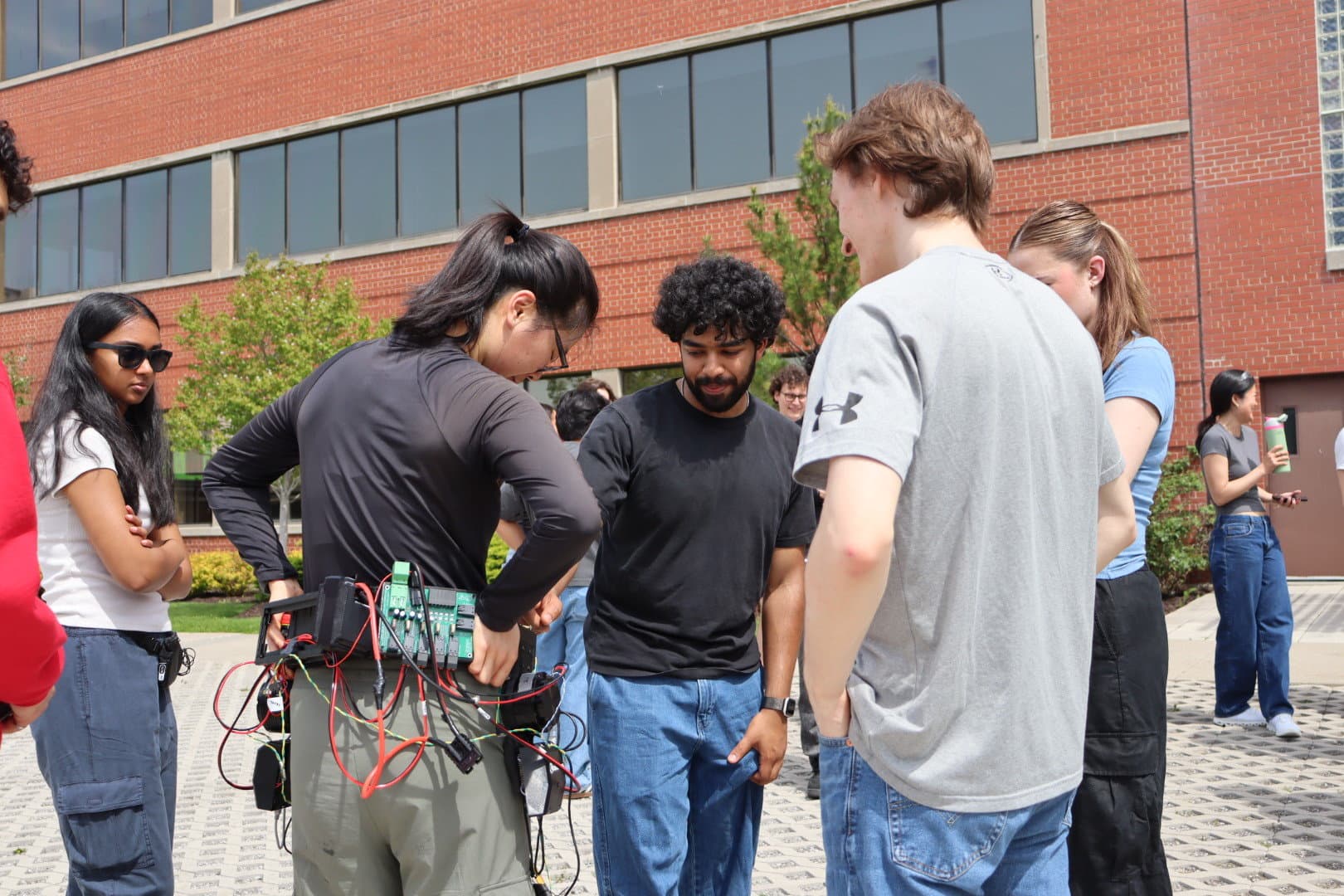
The electrical division has two subteams: Power Architecture and Actuation & Sensing. Power Architecture develops the suit’s power distribution and regulation. Actuation & Sensing integrates the sensors, motors and circuits that connect the suit to movement.
Responsibilities and expectations from the team’s 2026/27 application. Choose the area that fits your interests and experience.
01 / General member
Power Architecture
Design the electrical supply for the suit: regulate voltages and distribute power to its onboard systems. The work combines circuit design with practical board assembly and testing.
Power electronics
Altium or similar
PCB layout
Soldering
Electrical safety
What you’ll work on
Distribution and regulation
Develop circuits that regulate voltages and distribute power to the suit’s onboard systems.
PCB design
Turn power-circuit designs into board layouts using Altium Designer or similar PCB tools.
Assembly and validation
Solder, wire and assemble circuits, then test the physical hardware with electrical safety in mind.
System integration
Coordinate board placement, wiring and operation with mechanical and software teammates so the supply works within the wearable suit.
02 / General member
Actuation & Sensing
Design and integrate the sensors and motors that connect the suit to the pilot’s movement. Work spans IMU measurements, motor-control signals, circuit assembly and the wiring that brings the hardware together.
Circuit design
Sensors & motors
Embedded programming
Soldering
Wiring & testing
What you’ll work on
Circuits and components
Contribute to circuit design and select components for the suit’s sensing and actuation systems.
Sensors and motor signals
Integrate motion sensors and motors, connecting IMU measurements and motor-control signals to the rest of the system.
Hardware and code
Support embedded programming and work with software and mechanical teammates on the interfaces between their systems.
Assembly and testing
Solder, test and set up the hardware, following clean wiring and cable-management standards throughout the suit.
02 / Connecting the disciplines
Power and signals, brought together.
Electrical work connects the power supply, motion sensors and motor electronics. Those systems need physical space in the suit and interfaces that software can work with.
Electrical / Design areas
Select an area to explore
Four systems. Designed together.
These systems are developed in parallel rather than as a linear pipeline. Circuit design, component selection, PCB layout, assembly and testing support each area and the connections between them.
Inside the design area
Distribute power
The battery supplies the suit’s powered joints and onboard electronics. Distribution and voltage regulation provide the supply paths these systems need. Integrating them also means coordinating space for power hardware and connections within the waist structure.
Power distribution · Voltage regulation · Waist packaging
Inside the design area
Read movement
Motion sensors measure the orientation of body segments as the pilot moves. The circuits and connections designed around them carry those measurements to the onboard computer. Sensor mounting and wiring are coordinated with Mechanical, while Software reads and interprets the incoming data.
Circuit design · Sensor integration · Wiring
Inside the design area
Drive the joints
Motor electronics connect the electrical supply and software commands to actuation at the hip and knee. Their circuits, power connections and communication hardware sit alongside the moving assemblies, linking electrical design to control software and mechanical mounting.
Circuit design · Motor integration · Control signals
Inside the design area
Integrate protection
Fuses and emergency-stop hardware form part of the suit’s electrical protections. Packaging and wiring must accommodate these devices alongside the supply and motor connections. Their behaviour also has to be considered with software shutdown handling and the pilot’s physical controls.
Circuit protection · Emergency stop · System integration